
Why Organizing Your ABA Session Matters: Essential Tools for Parents and New BTs

Updated: Aug 18
A well-organized ABA session does not happen by accident. Whether you are a parent preparing your home for your child's therapist, or a new Behavior Technician (BT) setting up your very first sessions in New Jersey, the physical tools you use to structure time and tasks have a real, measurable effect on how smoothly a session runs. In New Jersey, many practices use the title BT (Behavior Technician) rather than RBT (Registered Behavior Technician), since not every technician has completed formal RBT certification yet, but the session organization tools below matter just as much either way.
It's Not Just New BTs Who Struggle With This
Here is something rarely said out loud: it is not only brand-new BTs who walk into a session like a deer in headlights, unsure how to start. Even experienced RBTs, and sometimes BCBAs themselves, were often never actually taught how to physically organize a session, what to have ready before the client arrives, how to structure the first five minutes, or how to keep a session moving smoothly between activities. Most training focuses heavily on clinical concepts and data collection, and very little time is spent on the practical, physical setup that makes a session actually run well. These two simple tools directly address that gap.
This is exactly why Imagination ABA Therapy sends both a timer and a chore chart directly to every new client before their very first session even begins. We would rather a family have these tools in hand and ready to go from day one, instead of scrambling to find something workable during an actual session.
Why Session Structure Matters So Much
ABA therapy relies heavily on predictability. Children with autism often experience anxiety around uncertain transitions, unclear expectations, or open-ended time. Two of the most effective, low-cost tools for reducing this uncertainty are a visual timer and a written daily schedule, both of which give a child (and a new BT) a concrete, external reference point instead of relying on abstract verbal reminders alone.
Disclosure: As an Amazon Associate, Imagination ABA Therapy earns from qualifying purchases.
Why a Visual, Non-Digital Timer Works Better Than a Phone Timer
Phones Are Also Distracting for the BT, Not Just the Client
Phones are distracting for both the BT and the client, in different but connected ways. A BT is often collecting data throughout a session, quick taps on the phone to log a target behavior or a correct response, which is itself already a necessary distraction from the activity at hand. The real problem comes right after: while the BT taps away at data collection, the phone's screen frequently goes dark, locks, or switches away from the timer entirely. In that moment, the client loses the visual timer completely, right when they may be relying on it most for a sense of clarity and direction. A dedicated mechanical timer never has this problem. It has exactly one job, showing time passing, and nothing about data collection, notifications, or screen locks ever interrupts it.
Digital timers on a phone or tablet create two problems in an ABA session: they pull a device into the room that can become its own source of distraction or demand, and they show time only as numbers, which is an abstract concept many young children have not yet mastered. A mechanical, wind-up kitchen timer solves both problems. It requires no batteries, so it is always ready, and its physical dial gives a child a visual sense of time passing simply by watching the dial move, without needing to understand what a number like '7 minutes' actually means.
A simple option that works well for this exact purpose is a 60-Minute Mechanical Wind-Up Kitchen Timer like this one, Available on Amazon, requiring no batteries, with a large, easy-to-read dial and a magnetic back that lets it stick right to a fridge or metal chore board during a session. As the timer runs, the client can watch the time visually decrease rather than watching a digital number change, which makes an abstract concept like time much easier to understand. It is also simple enough that a client can change or start it themselves. If a client wants more time, you can easily add a few extra minutes with a clear, visual adjustment rather than just announcing a new number.


What About Other Visual Timers, Like Time Timer?
The most well-known visual timer in ABA and classroom settings is the Time Timer, recognizable by its red disappearing disc. It is a genuinely good, research-backed tool, but it typically requires 2 AA or AAA batteries and usually costs $30 to $40 or more depending on the size. A mechanical, wind-up kitchen timer accomplishes the same core goal, giving a child a visual, non-digital sense of time passing, without any of the battery-related downsides: no batteries to lose, no batteries dying mid-session, no remembering to carry spares between homes if you serve multiple families, and no ongoing cost to replace them. The kitchen timer version also typically costs under $10 on Amazon, making it an easy, low-risk tool to keep in every session bag without a second thought.
Why a Reusable, Erasable Chore Chart Beats a Printed One
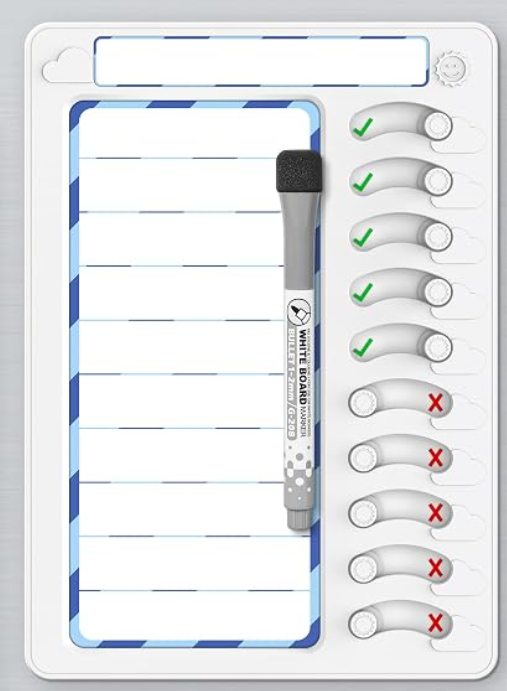
Many families start with a printed schedule taped to the wall, only to find it becomes outdated within a week as goals shift. A dry-erase daily chore or schedule board solves this directly: a BT or parent can write the day's specific tasks each morning, check them off as the session progresses, and wipe it clean to start fresh the next day. This also gives a child a visual representation of exactly what is happening now and what comes next, which is a core structural strategy in ABA sessions, sometimes called a first-then or visual schedule system.
A straightforward option for this is a reusable dry-erase daily chore and schedule board, which lets you rewrite the day's tasks each morning and erase it clean afterward, no printing or laminating required.
Our Own Age-Differentiated Schedule Templates
At Imagination ABA Therapy, we also created our own set of fixed, pre-designed 'Today's Schedule' templates, built specifically for three different age groups: younger children ages 3 to 5, school-age children ages 6 to 10, and older children and teens ages 11 to 14. Each one uses bright, engaging visuals and age-appropriate activities, from circle time and outdoor play for younger kids to homework blocks and independent reflection for teens, and every version includes a spot for a parent note.

The Genuine Value of a Set Template Like This
These templates are genuinely useful in the right context: they are visually appealing, give a child immediate structure without any setup, and work especially well for routines that stay fairly consistent, like an after-school block or a summer day. We are proud of these and use them as a real resource for families.
Why a Reusable Board Still Matters Alongside It
The honest tradeoff with any fixed template, including our own, is flexibility. A real ABA session rarely follows the exact same activities at the exact same times every single day; goals shift, reinforcers change based on what is motivating that day, and a BT often needs to adjust the plan in the moment based on how a child is responding. This is exactly why we recommend pairing a set template like ours for overall routine structure with a reusable, erasable board for the specific, day-to-day session details that genuinely do change daily.
A Note for New BTs Starting in New Jersey
If you are a new BT beginning your first sessions, investing a small amount in these two simple tools before your first day is one of the most practical things you can do. They cost far less than most other classroom or therapy materials, they require no setup beyond winding a dial or writing with a marker, and they immediately signal structure to a child from the very first session, which builds trust and predictability faster than verbal instructions alone.
How Imagination ABA Approaches Session Structure
At Imagination ABA Therapy, every BT and RBT is trained to build predictable structure into each session from day one, using visual and physical tools exactly like these alongside individualized data collection. If you are a parent curious how session structure works in practice, or a BT interested in joining our New Jersey team, we would love to hear from you.
Connect with Imagination ABA Therapy: Contact Us | Psychology Today | LinkedIn | Facebook | ABA Navigator


Comments