
Biking With Safety: Ride With Traffic, Not Against It

Part of the Family Safety Series, an initiative by Imagination ABA Therapy in partnership with WeeRsafe.
Watch any street on a nice afternoon and you'll see it: kids, teens and even adults riding bikes on the left side of the road, facing oncoming cars. It feels safer, because you can see what's coming. It's actually one of the most dangerous ways to ride, and in New Jersey it's against the law. The rule is simple: walk facing traffic, ride with traffic.
What can go wrong

Twelve-year-old Jake rides to his friend's house on the left side of the street, facing the cars, the way he learned to walk. A driver pulling out of a driveway looks left for traffic, sees nothing, and starts to turn right. Jake is coming from the right, exactly where the driver isn't looking.
The same moment, done right
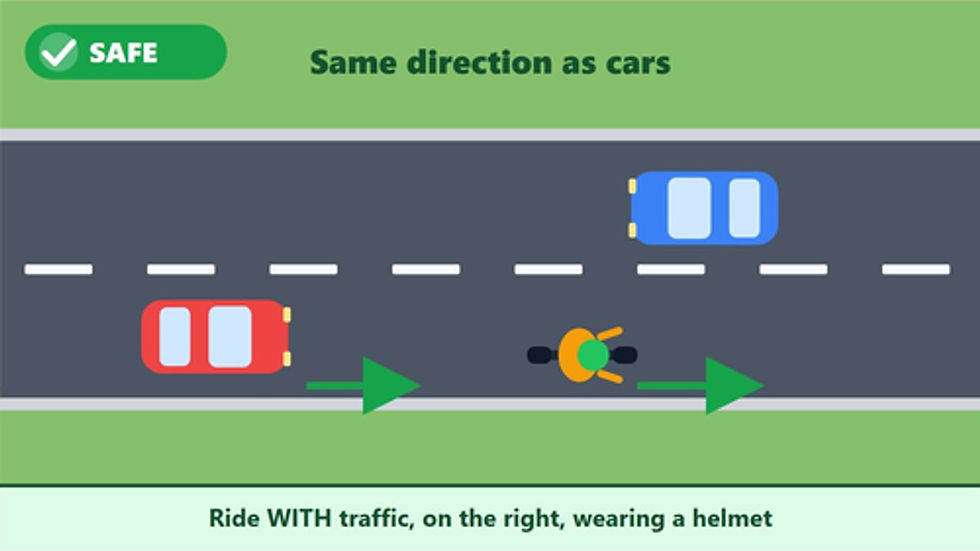
Same street. Jake rides on the right side, in the same direction as the cars, wearing his helmet. The driver at the driveway looks left, sees Jake coming in the flow of traffic, and waits for him to pass.
How it works
Walking (no sidewalk): left side, facing traffic, so you can see cars coming and step out of the way.
Riding a bike: right side, same direction as traffic. A bike is a vehicle, and New Jersey law requires riders to go with traffic and stay as far right as is practical.
Riding with traffic puts you where drivers look, lets you follow signs and signals, and makes your moves predictable.
Why it works
Speeds add up. When a 10 mph bike rides toward a 30 mph car, they close in at 40 mph. Riding the same direction, the car gains on you at only 20 mph, and the driver has been seeing you the whole time. Half the closing speed means double the time to react.
How much more time does the driver get? Say a driver spots you 200 feet away:
Riding against traffic (40 mph closing speed): about 3.4 seconds before you meet. Most drivers need about 1.5 seconds just to react, which leaves less than 2 seconds to brake or steer around you.
Riding with traffic (20 mph closing speed): about 6.8 seconds, twice as long. After reacting, the driver still has more than 5 seconds to slow down and move over.
If a crash does happen: hitting at 40 mph carries about four times the force of hitting at 20 mph.
The left turn: where drivers never look

Think about what a driver does when turning left off a main road. Their eyes are straight ahead, watching oncoming cars and waiting for a gap. When the gap comes, they go. They are not looking back over their shoulder at the side of the road they're turning across, because nothing traveling the right way would be coming from there.
A cyclist riding against traffic on that side comes from exactly that direction: from behind the driver. The driver never had a chance to see them. These crashes happen far more often than people think, and we've seen one happen with our own eyes.
Sidewalk riding makes it worse. Riders on the sidewalk, especially ones going against traffic, often roll off the curb and across the street at full speed, as if they're invincible. A turning driver is watching the road, not the sidewalk, and simply doesn't see them coming. Sidewalks are for people walking. Ride in the road, with traffic. When you need to cross, stop at the curb, look both ways, make eye contact with drivers, or get off and walk the bike across the crosswalk.
Young children who are still learning may ride on the sidewalk with a grown-up where local rules allow, but they should always ride in the same direction as traffic and stop at every driveway and corner.
The other essentials
Helmet, every ride. In New Jersey, anyone under 17 is required by law to wear one. It should sit level, two fingers above the eyebrows, strap snug.
Be seen: bright colors by day; front light, rear light or reflector and reflective gear at dusk.
Use hand signals for turning and stopping.
Stop at every stop sign and red light.
Watch for driveways, reverse lights and opening car doors.
Quick bike check: tires, brakes, chain.
Extra tips for children with autism
Practice one route at a time: walk it first, then ride it together.
Use a picture card: "Ride on the right side, same way as cars." Your child's ABA therapist or OT can help build it into their routine.
One non-negotiable rule: stop at every curb and corner and wait for a grown-up.
Add a helmet sticker or ID bracelet with a caregiver's phone number, and lock bikes away if your child tends to wander.
Bike safety is one part of a bigger picture. If you're worried about wandering, water safety or making your home safer for a child with autism, visit WeeRsafe.com to book a home safety assessment.
A Safety Initiative by Imagination ABA Therapy
The Family Safety Series is an initiative by Imagination ABA Therapy, providing in-home ABA therapy to families across New Jersey. Keeping children safe at home, at school and in the community is part of everything we do, so we're sharing what we know with every family.
We're proud to promote WeeRsafe, the childproofing and home safety team with a special focus on families of children with autism. From door alarms and pool gates to anchoring furniture, WeeRsafe helps make every room safer.
More to come! New safety guides are on the way. Follow along so you don't miss the next one.
Follow us for more safety tips: Facebook | Psychology Today | LinkedIn | WhatsApp


Comments